
Table of Contents
- Why Sensitive Skin Needs a Different Primally Pure Alternative
- How We Evaluate Sensitive Skin Compatibility
- Sensitive Skin Skincare Ingredients to Avoid in Any Alternative
- Product-by-Product Alternatives Matched to a Primally Pure Routine
- Natural Skincare for Sensitive Skin: What to Look For Instead
- How to Patch Test Skincare Products Before Switching
- Price and Value: What You Pay Per Ounce
- Frequently Asked Questions
Last Updated: October 19, 2026
Why Sensitive Skin Needs a Different Primally Pure Alternative
If your skin stings, flushes, or tightens after a product that works fine for everyone else, the problem is usually not your skin being "difficult." It is the formula. A Primally Pure alternative for sensitive skin has to clear a higher bar than a general natural product, because reactive skin reacts to things that clean beauty marketing rarely mentions: essential oils, botanical extracts, and fragrance blends that are technically plant-derived.
At CHOSEN WELLNESS, we curate by skin goal rather than by trend, which means we screen a short list instead of a long one. Below, we walk through how to evaluate any alternative, which ingredients deserve scrutiny, and which products match each step of a Primally Pure routine.
What 'Clean' and 'Non-Toxic' Claims Actually Tell You
Almost nothing, in regulatory terms. The words "clean," "non-toxic," and "natural" are marketing language, not regulated categories. A brand can print them on any label without meeting a standard.
What you can actually verify is the ingredient list, the order of ingredients, and whether fragrance appears as a specific component or a catch-all. Read labels the way you read a contract: line by line, looking for what is vague.
How We Evaluate Sensitive Skin Compatibility
Our screening method is simple and repeatable. Score any candidate product against four checks before it earns a place in your routine:
- Fragrance disclosure: specific essential oils named, or a generic fragrance term
- Ingredient count: shorter lists mean fewer variables to react to
- Known irritant flags: drying alcohols, strong botanical extracts, exfoliating acids in a leave-on product
- Barrier support: does it contain occlusives, fatty acids, or humectants that help skin hold water
A product that fails two or more checks is not automatically bad, but it is a poor first choice for reactive skin. Start with the products that pass the most checks.
Sensitive Skin Skincare Ingredients to Avoid in Any Alternative
The most common triggers in natural skincare are not synthetic at all. They are plant-derived, and they are everywhere.
- Essential oils such as lavender, citrus, peppermint, and eucalyptus
- Fragrance oils, whether synthetic or naturally derived
- Drying alcohols high in an ingredient list
- Strong exfoliants used more than a few times a week
- Undisclosed botanical blends you cannot identify
Essential Oils, Synthetic Fragrance, and the Fragrance-Free Trade-Off
Here is the tension most guides skip: fragrance-free formulas often smell like nothing, and that is the point. Naturally scented formulas can be gentler than synthetic fragrance for some people, but not for all. A rose or lavender oil is still a fragrance, and reactive skin does not distinguish between the two.
The honest answer is that fragrance tolerance is individual. Choose the least scented option you can tolerate, and treat any scented product as something to patch test rather than assume.
Product-by-Product Alternatives Matched to a Primally Pure Routine
Most alternatives articles swap one brand for another wholesale. That is the wrong move for reactive skin, because a full routine change introduces a dozen new variables at once. The better approach is to replace one Primally Pure product at a time, matching each substitute to the role the original played in your routine. Every product is available through our curated collection.
Replacing Primally Pure Everything Spray (toner step): AquaPlush Skin Hydration Cream ($27.99, 2 oz). Primally Pure's Everything Spray is a liquid toner with apple cider vinegar and essential oils; if your skin stung with it, the issue is usually the vinegar acidity plus the fragrance. AquaPlush swaps the liquid toner step for a hyaluronic acid cream layer. If you are fragrance-sensitive, skip this and use the shea butter below as your only hydrating layer until your skin calms.


Replacing Primally Pure Baby Balm or Body Butter (occlusive step): Velvet Reserve Pure Shea Butter ($29.75, 4 oz). One ingredient, unrefined shea butter, no added fragrance. This is the safest starting point if you are actively reacting to something and need to strip your routine back to a single product. Trade-off: shea is a tree nut derivative, so patch test if you have a known nut allergy.
Replacing Primally Pure Blue Tansy Mask (treatment step): There is no direct one-for-one substitute here, and that is worth saying plainly. Blue tansy masks rely on botanical azulene and essential oils for their color and scent, which are common triggers. For reactive skin, the honest replacement is to drop the treatment step entirely for two to four weeks and reintroduce a single gentle exfoliant only after your barrier is calm.
Replacing Primally Pure Facial Cleanser (cleanse step): None of the products in our current collection is a dedicated cleanser, so the practical substitute is a fragrance-free, non-foaming cleanser from a mass-market sensitive-skin line, used with lukewarm water and no washcloth. The goal at the cleanse step is to remove sunscreen and oil without stripping, and a plain lotion cleanser does that with fewer variables than a botanical gel.
Fresh Face Cream Anti-Aging Tallow Moisturizer →
Replacing Primally Pure Everything Cream or Facial Serum (moisturizer step): Fresh Face Cream Anti-Aging Tallow Moisturizer ($55.00, 0.78 fl oz) for dry, barrier-compromised skin, or Peptide Moisturizer ($27.99, 1.7 fl oz) for normal-to-combination skin with aging concerns. Fresh Face Cream is a tallow and shea base with squalane and jojoba, built for dry and reactive skin. It does contain several essential oils, including lavender, frankincense, rosemary, and rose, plus tamanu oil, which is a tree nut oil.

| Primally Pure product being replaced | Closest alternative | Price | Fragrance status | Key trade-off |
|---|---|---|---|---|
| Everything Spray (toner) | AquaPlush Skin Hydration Cream | $27.99 | Cucumber fragrance oil | Not for fragrance-reactive skin |
| Baby Balm / Body Butter (occlusive) | Velvet Reserve Pure Shea Butter | $29.75 | None added | Tree nut derivative; patch test |
| Blue Tansy Mask (treatment) | No direct substitute; drop the step | , | , | Reintroduce exfoliation only after barrier calms |
| Facial Cleanser (cleanse) | Fragrance-free lotion cleanser (mass-market) | Varies | Fragrance-free | Not sold in our collection |
| Everything Cream / Facial Serum (moisturizer) | Fresh Face Cream or Peptide Moisturizer | $55.00 / $27.99 | Essential oils / botanical extracts | Fresh Face Cream has nut oil and essential oils |
Natural Skincare for Sensitive Skin: What to Look For Instead
Look for short lists, named ingredients, and a clear role for each product. Natural skincare for sensitive skin works best when it does less: a gentle cleanser, one hydrating layer, one occlusive to seal it in, and sunscreen in the morning.
Skip the ten-step routine. Reactive skin benefits from repetition and predictability far more than from novelty. Add one product at a time and give it a week before adding the next.
How to Patch Test Skincare Products Before Switching
Patch testing is the cheapest risk management in skincare. Apply a small amount to the inner forearm, twice daily, for three to five days. If there is no redness, itching, or stinging, repeat the test on a small area behind the jaw before using it on your full face.
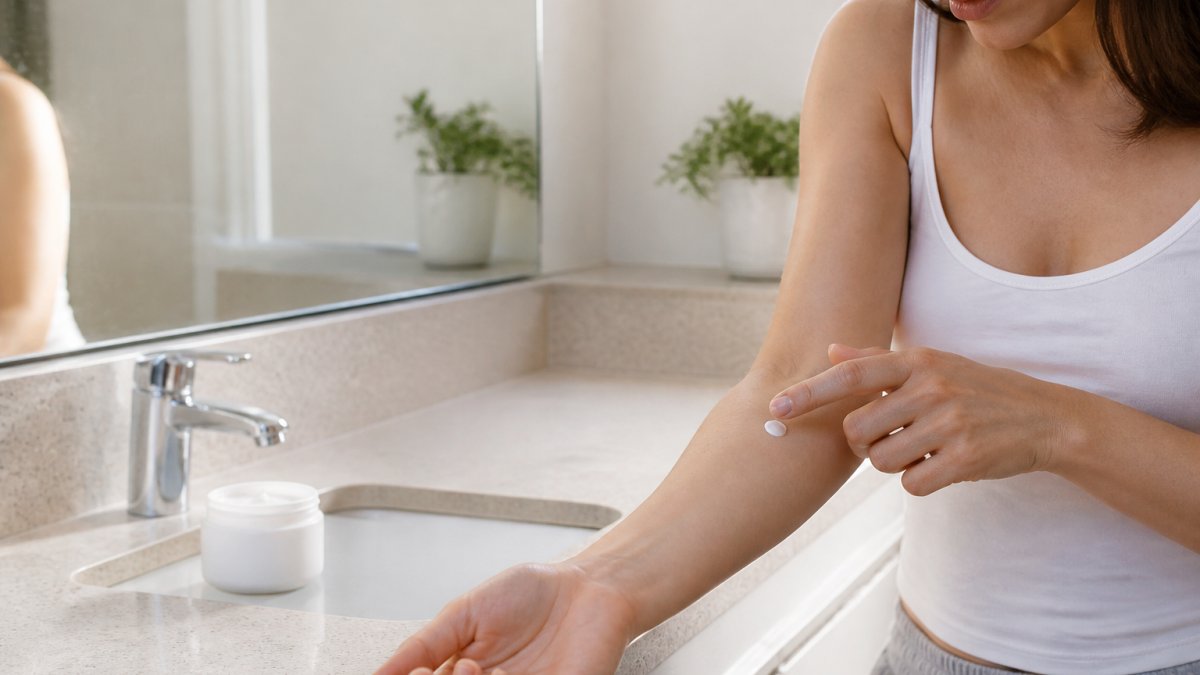
Stop immediately if you feel stinging that lasts more than a minute. A brief tingle is not a sign the product is "working." It is a sign your skin is reacting.
Price and Value: What You Pay Per Ounce
Value in skincare is not the sticker price. It is cost per ounce against how long the product actually lasts and how much of it you can use without irritation. A $55 jar that lasts three months costs less per month than a $28 jar you abandon after two weeks because it stings.
The table below compares the alternatives in this article on a cost-per-ounce basis, using listed sizes and prices as of October 19, 2026. Prices and sizes can change; recheck before buying.
| Product | Price | Cost per ounce | Notes |
|---|---|---|---|
| Velvet Reserve Pure Shea Butter | $29.75 | $7.44/oz | Single ingredient; a thin layer covers a lot of surface area |
| AquaPlush Skin Hydration Cream | $27.99 | $14.00/oz | Scented; not for fragrance-reactive skin |
| Peptide Moisturizer | $27.99 | $16.46/fl oz | Aloe and witch hazel base |
| Fresh Face Cream Anti-Aging Tallow Moisturizer | $55.00 | $70.51/fl oz | Most expensive per ounce; small, concentrated jar |
The shea butter is the clear value leader at $7.44 per ounce, and it is also the safest starting point for reactive skin because it has one ingredient. The Fresh Face Cream is the most expensive per ounce because it is a small, concentrated jar, but a pea-sized amount covers the face, so the jar lasts longer than the size suggests. The AquaPlush and Peptide Moisturizer sit in the middle on cost per ounce; their value depends on whether your skin tolerates their fragrance and botanical content.
A realistic routine cost for reactive skin is lower than a full Primally Pure routine, not because the individual products are cheaper, but because you need fewer of them. A fragrance-free cleanser, one hydrating layer, one occlusive, and sunscreen is four products. If you are replacing a multi-step Primally Pure routine, the monthly cost usually drops even when the per-ounce price of one substitute is higher.
Frequently Asked Questions
What is the best Primally Pure alternative for sensitive skin?
There is no single best option, because sensitive skin reacts to different ingredients. Start by screening for fragrance-free or low-fragrance formulas and short ingredient lists. Pure shea butter is the simplest starting point for dry, reactive skin, while a hyaluronic acid cream suits skin that needs hydration without heavy oils. Patch test any new product on your inner forearm for 48 to 72 hours before using it on your face, and introduce one product at a time so you can tell what caused a reaction.
What ingredients should people with sensitive skin avoid in skincare?
The most common triggers are added fragrance, essential oils, drying alcohols, and strong exfoliating acids. Watch for lavender, citrus, peppermint, and eucalyptus oils, which appear in many natural formulas. Also check for propolis, bee-derived ingredients, and tree nut oils if you have known allergies. Read the full ingredient list rather than the front label, since 'natural' and 'clean' are not regulated claims and say nothing about whether a formula will irritate reactive skin.
How do I patch test a new skincare product?
Apply a small amount to the inside of your forearm or behind your ear and leave it uncovered for 48 to 72 hours. Check for redness, itching, stinging, or swelling at 24, 48, and 72 hours. If there is no reaction, test a small area on your jawline for two to three days before applying to your full face. Stop using the product at the first sign of irritation, and keep a note of the ingredients so you can spot the pattern next time.
Are natural or organic products always gentler on sensitive skin?
No. Botanical ingredients can irritate skin as readily as synthetic ones, and essential oils are a frequent cause of contact reactions. 'Organic' refers to how an ingredient was grown, not to how gentle it is. What matters is the specific formula: whether fragrance is added, how many plant extracts are packed in, and whether the product supports your skin barrier with ingredients like shea butter, squalane, or hyaluronic acid.
How much should I expect to spend on a gentle alternative?
Prices vary widely by product type and size, so compare cost per ounce rather than the sticker price. A 4 oz tub of pure shea butter at $29.75 works out to roughly $7.44 per ounce and covers face, body, and hair, while a 1.7 fl oz facial moisturizer at $27.99 is about $16.46 per ounce. Smaller facial products cost more per ounce but last longer, so factor in how often you will actually use each one.