
Table of Contents
- Why Shoppers Look for a Detox Market Alternative for Wellness
- How Curated Wellness Retailers Compare on Selection and Standards
- Clean Beauty Stores: What Separates Curation From Clutter
- Curated Skincare Products That Match Your Wellness Goals
- Natural Skincare for Sensitive Skin: How to Choose Without Trial and Error
- Price, Shipping, and Returns: A Value Breakdown
- Which Wellness Retailer Fits Your Routine?
- Conclusion
- Frequently Asked Questions
Last Updated: October 21, 2026
Why Shoppers Look for a Detox Market Alternative for Wellness
Shoppers searching for The Detox Market alternative for wellness don't want a bigger store, they want a smaller, more decisive one. The Detox Market built its reputation on clean beauty curation, but as the category matures, shoppers shift from "show me everything clean" to "show me what works for me."
At CHOSEN WELLNESS, we hear the same question repeatedly: why does finding a good vitamin or serum still feel like a part-time job? Most retailers optimize for catalog size, not outcomes, forcing you to become your own researcher.
Three things push shoppers to look elsewhere:
- Selection fatigue. Endless scrolling replaces expert editing. You end up comparing 40 cleansers instead of choosing one.
- Weak wellness depth. Many clean beauty retailers treat supplements as an afterthought, which splits your routine across two or three stores.
- Unclear standards. "Clean" has no single legal definition in the United States, so every retailer sets its own bar. The FDA's guidance on cosmetic labeling and claims is a useful starting point for understanding what brands can and cannot legally claim.
How Curated Wellness Retailers Compare on Selection and Standards
Curated wellness retail limits a store's catalog to hand-picked products organized around specific health or skin goals, rather than stocking every brand that applies. The model lives or dies on how narrow the edit is and how clearly the store explains why each product made the cut.
| Retailer Type | Selection Depth | Wellness Focus | Typical Standard |
|---|---|---|---|
| Clean beauty marketplaces | Very broad | Skincare-first, supplements secondary | Retailer-defined "clean" list |
| Subscription curation boxes | Narrow, rotating | Mixed | Editor or expert panel picks |
| Goal-based curated shops | Narrow, stable | Skincare and supplements together | Products grouped by outcome |
| Mass beauty retailers | Enormous | Minimal | Little to no ingredient screening |
A broad marketplace lets you find a specific ingredient if you already know what you want; a goal-based shop helps you decide what you want in the first place.
What "Clean" Actually Means at Each Retailer
"Clean" has no single legal definition in the United States. The FDA regulates cosmetic labeling and safety but does not certify products as "clean," "natural," or "organic," so every retailer writes its own rulebook. When you compare alternatives, ask which of these four approaches the store uses:
- A published exclusion list. The retailer names specific ingredient families it will not stock (for example, certain parabens, phthalates, or synthetic fragrances) and links to the list from every product page. This is the most verifiable standard because you can check a product's ingredient panel against it.
- A third-party certification requirement. The retailer requires brands to hold a recognized certification, such as USDA Organic for agricultural ingredients or a comparable independent seal, and displays the certificate. Certification is narrower than a blanket "clean" claim but easier to audit.
- An internal review panel. The retailer says a team of formulators, estheticians, or nutritionists reviews every product. This can be rigorous, but the criteria are usually private, so you are trusting the panel rather than checking a list.
- A marketing filter. The retailer uses "clean" as a search tag with no published criteria. This is the weakest standard because almost anything can pass.
A store that publishes its exclusion list and shows certification gives you something verifiable; a store that only shows a badge is asking you to take its word.
How to Verify a Wellness Retailer's Standards Before You Buy
You don't need a lab to pressure-test a curation claim. Four checks take about ten minutes:
- Read the exclusion list, not the badge. Find the page that names excluded ingredients. If the only statement is "free from harsh chemicals," the standard is undefined.
- Cross-check one product. Pick a serum or supplement and compare its ingredient panel to the retailer's exclusion list. If the panel contains something the list says it excludes, the curation is not being enforced.
- Check who stands behind the claim. The FTC's guidance on advertising claims and endorsements governs how retailers and brands can describe results, and the FDA's guidance on cosmetic labeling and claims sets the line between cosmetic and drug claims. A store that leans on vague, unfalsifiable language is usually compensating for a thin edit.
Where the Models Diverge on Wellness Depth
The biggest practical gap between alternatives is supplements. Clean beauty marketplaces typically treat supplements as secondary, so you may find a good serum and a thin vitamin aisle in the same store. Goal-based curated shops that stock both let you build a routine in one place, but only if their supplement standards are as explicit as their skincare standards. Score each retailer on both halves of the catalog separately.
Clean Beauty Stores: What Separates Curation From Clutter
Clean beauty stores fall into two camps. The first edits ruthlessly and can explain every inclusion.
We look for four signals when judging whether a clean beauty store is actually curating:
- A stated standard. The retailer publishes what it excludes and why, not just a badge on the product page.
- A finite catalog. You can browse the entire skincare section in a few minutes.
- Goal-based navigation. Products are grouped by concern, such as hydration, glow, or sensitivity, rather than by brand.
- Reasoning attached to picks. Each product has a short explanation of who it's for.
"Great for dry skin" is marketing; "this is for you if your skin feels tight after cleansing but breaks out from heavy creams" is curation.
The FTC's guidance on advertising claims and endorsements is worth knowing here, because it governs how retailers and brands can describe results.
Curated Skincare Products That Match Your Wellness Goals
Curated skincare products work best when chosen for an outcome, not a category. Most routines fail because people buy a cleanser, a serum, and a moisturizer independently and wonder why the combination doesn't deliver.
Here's how we'd map a few common goals to specific picks from our own collection:
| Your Goal | Product | Price | Why It Fits |
|---|---|---|---|
| Glow and hydration | whamisa Organic Algae Kelp Mask 5ea | $65.00 | Kelp sheet masks that hydrate and reduce puffiness |
| Antioxidant support from within | Nutrex BioAstin Hawaiian Astaxanthin 4mg | $33.00 | 4 mg natural astaxanthin per softgel, for skin radiance and antioxidant protection |
| Daily energy and hydration | Advanced Daily Nutrition - Formulated for Her | $29.99 | Daily multivitamin built for energy, absorption, and glow |
| Prenatal support | Essential Prenatal Nutrition + Electrolytes | $51.93 | Prenatal nutrition with electrolytes for energy and absorption |
| Shared wellness routine | Couples' Wellness Pack | $89.99 | Hydrating multivitamin for her and him, in one set |
The mask is the easiest entry point if you want a visible result before committing to a supplement routine. Apply the bottom sheet, then the top, leave it for 10 to 20 minutes, and tap in the remaining essence without rinsing.


Natural Skincare for Sensitive Skin: How to Choose Without Trial and Error
Natural skincare for sensitive skin is less about avoiding synthetic ingredients and more about minimizing variables. Reactive skin usually isn't reacting to "chemicals" in general.
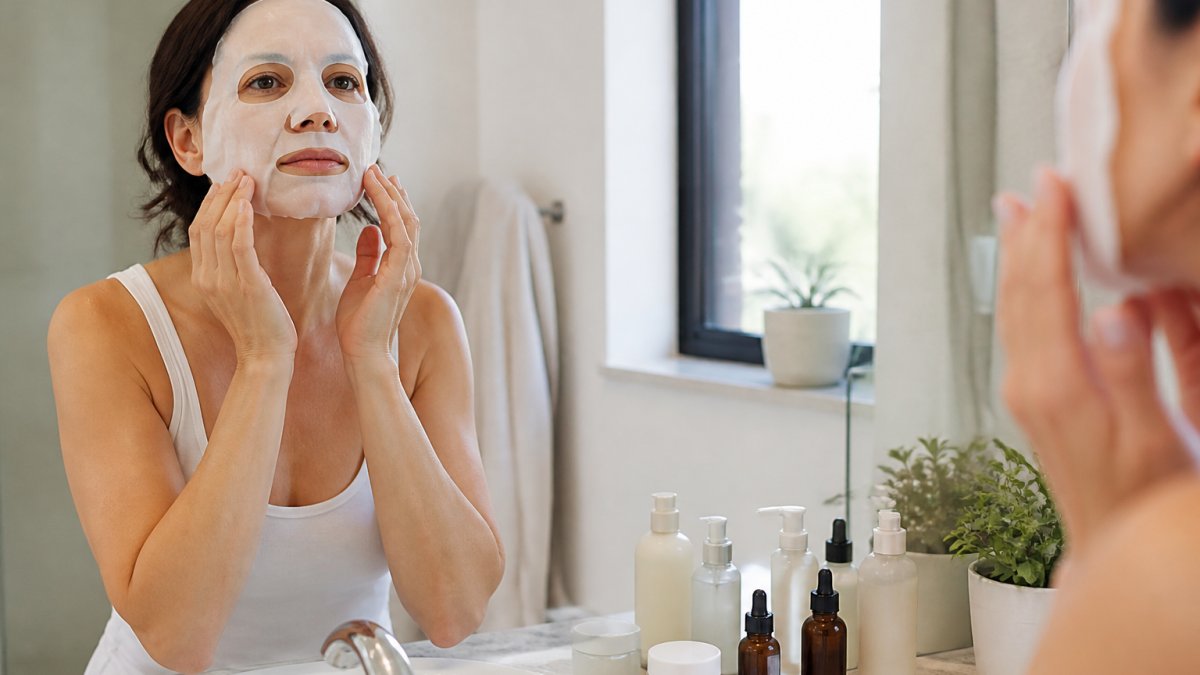
Every new product resets the clock, and if you introduce three at once, you learn nothing when your skin flares.
A better approach:
- Introduce one product at a time. Give it two weeks before adding anything else.
- Patch test first. Apply a small amount behind the ear or on the inner forearm and wait 24 hours.
- Favor short ingredient lists. Fewer ingredients means fewer suspects.
If a reaction does occur, stop the product and let your skin settle before testing anything else.
Advanced Daily Nutrition - Formulated for Her →
Price, Shipping, and Returns: A Value Breakdown
Price comparisons between curated retailers are misleading unless you account for what the curation replaces. A $65 mask looks expensive next to a drugstore sheet mask, but reasonable next to three $25 masks you bought, tried once, and abandoned.
Here's the honest value math we'd run:
- Cost per decision. A curated store narrows 40 options to three. That's hours of research you don't do.
- Cost per wasted product. Half-used bottles are the most expensive thing in your bathroom. A tighter edit reduces the odds.
- Cost per routine. Buying a cleanser, serum, and supplement from three stores means three shipping charges and three return processes.
Typical Price Ranges Across Retailer Types
Sticker prices vary more by category than by retailer, but these ranges are a useful benchmark. Treat them as planning ranges, not quotes, and confirm current prices on each store's product pages.
| Category | Mass Retailer Range | Curated Clean Retailer Range | What Drives the Difference |
|---|---|---|---|
| Facial serum (1 oz) | $10-$25 | $35-$95 | Ingredient sourcing, smaller batch sizes, certification costs |
| Sheet mask (single) | $2-$5 | $8-$15 | Fabric quality, essence concentration, per-unit packaging |
| Daily multivitamin (30-day) | $8-$20 | $25-$55 | Third-party testing, chelated forms, dose transparency |
| Specialty supplement (30-day) | $12-$30 | $30-$60 | Patented ingredients, clinical-dose formulations |
| Body care (8 oz) | $8-$18 | $20-$45 | Exclusion-list compliance, organic ingredients |
Curated stores run roughly two to four times the mass-retail price in most categories. The question is whether the edit, standards, and testing justify the premium for you.
Shipping Thresholds and Delivery Windows
Shipping decides the total cost of a routine. A store with a low free-shipping threshold can be cheaper than one with lower sticker prices but a high threshold. Check four things:
- Free-shipping threshold. Many curated retailers set it between $50 and $75. If your routine lands at $48, you may be paying $6 to $9 in shipping to save nothing.
- Flat-rate and expedited options. A flat ground rate is usually the best value for a single-item order; expedited shipping rarely makes sense for skincare or supplements you will use for weeks.
- Delivery window. Standard ground delivery commonly runs three to seven business days. Perishable or temperature-sensitive supplements may ship with restrictions, so confirm before ordering in warm months.
Return Policies: What to Confirm Before You Open the Seal
On returns, our policy is straightforward: we accept returns on unopened items within 30 days. That's common among curated retailers, but confirm it before you buy anywhere. Opened skincare and supplements are typically excluded for hygiene and safety, which is why patch testing matters.
The variation is in the details, and the details are where shoppers get surprised:
- Return window. Thirty days is common, but some stores allow 14 and some allow 60. The clock usually starts at delivery, not order date.
- Opened-product policy. Most curated retailers exclude opened skincare and supplements. A few offer a one-time exception for a reaction, usually with a photo or a customer-service conversation. Ask before you buy if you have reactive skin.
- Restocking fees. Rare for consumer skincare, but some supplement retailers apply a fee on large orders. Check the fine print on multi-packs and sets.
Running the Total-Cost Comparison
To compare alternatives fairly, build a single basket: one cleanser, one serum, one daily supplement, and one specialty supplement. Add sticker prices and shipping for each store, subtract any free-shipping threshold you cross, and note each return window. The lowest total isn't always the best value, but the exercise exposes stores that look cheap on the product page and expensive at checkout.
Which Wellness Retailer Fits Your Routine?
The right The Detox Market alternative for wellness depends on how you shop, not on catalog size. Match the model to your habits:
| If You... | Choose |
|---|---|
| Already know the exact ingredient you want | A broad clean beauty marketplace |
| Want to be surprised each month | A subscription curation box |
| Want to shop by concern and stop researching | A goal-based curated shop |
| Buy supplements and skincare together | A retailer with real wellness depth |
| Shop for gifts without knowing skin types | A curated shop with sets and goal-based picks |
For most readers, the third and fourth rows are the answer. If you're 45 with combination skin and fine lines, you don't need 200 serums, you need someone to narrow the field to a hydrating mask, an antioxidant supplement, and a daily multivitamin, then explain the order to use them in.
That's the case for switching. Not because a curated retailer stocks more, but because it stocks less and can defend every item.
Conclusion
The hardest part of a wellness routine isn't discipline, it's deciding what to buy, and most retailers make that harder by handing you the entire catalog.
CHOSEN WELLNESS is built around that idea. If your goal is metabolic rather than skin-deep, the Appetite Balance & Weight Support Strips sit in the same goal-based framework as our skincare, so you're not piecing a routine together across three stores.
Get started with CHOSEN WELLNESS and shop by goal to build a routine that fits your skin, your supplements, and your schedule.
Frequently Asked Questions
What are the best alternatives to The Detox Market for wellness?
The right wellness alternative depends on whether you want marketplace breadth or a tight, goal-based edit. A curated retailer such as CHOSEN WELLNESS organizes products by outcome, so you shop for glow, hydration, or sensitive-skin support instead of scrolling hundreds of brands. Compare candidates on four points: how many brands they carry, whether they publish full ingredient lists, what their return window is, and whether they sell supplements alongside skincare. A smaller catalog with clear verification usually beats a huge one you have to filter yourself.
How do I choose a clean beauty store for sensitive skin?
Start with the ingredient list, not the marketing label. Look for retailers that publish full INCI lists on the product page so you can check for fragrance, essential oils, and alcohol before buying. Then confirm the return policy covers unopened items, since patch testing takes time. A store that groups products by concern, such as a sensitive-skin or barrier-repair edit, saves you from guessing. CHOSEN WELLNESS lists full ingredients on items like the Whamisa Organic Algae Kelp Mask and accepts 30-day returns on unopened products.
What is the difference between a clean beauty marketplace and a curated skincare collection?
A marketplace stocks as many brands as possible and lets you filter. A curated skincare collection does the filtering for you, carrying fewer products chosen against a stated standard. The trade-off is breadth versus confidence: marketplaces win on variety, curated collections win on decision speed and consistency. If you already know exactly which brand and formula you want, a marketplace makes sense. If you keep buying products that end up half-used, a curated edit with goal-based shopping removes the guesswork.
Are curated wellness products worth the higher price compared with buying individually?
The premium pays for selection work, not just the bottle. At CHOSEN WELLNESS, prices run from $29.99 for Advanced Daily Nutrition to $89.99 for the Couples' Wellness Pack, with skincare such as the Whamisa Kelp Mask 5-pack at $65.00. What you get for that is a shorter list to evaluate, published ingredient detail, and a 30-day return window on unopened items. If a product does not suit you, the return policy matters more than a few dollars of savings elsewhere.
How can I find skincare and supplements that match my wellness goals?
Write down the outcome you want first, such as fewer fine lines, better hydration, or more daily energy, then buy only products that name that outcome. CHOSEN WELLNESS builds its catalog around shop-by-goal navigation, so a radiance goal points you to items like Nutrex BioAstin Hawaiian Astaxanthin at $33.00, while hydration points to the Whamisa Kelp Mask. Keep the routine to three or four products for eight weeks before adding anything, so you can tell what is actually working.
These statements have not been evaluated by the Food and Drug Administration. These products are not intended to diagnose, treat, cure, or prevent any disease.