
Table of Contents
- Why Simple Body Rituals Beat a Ten-Product Shelf
- Step 1: Gentle Cleansing With a pH-Balanced Body Wash
- Step 2: Build a Body Exfoliation Routine That Respects Your Barrier
- Step 3: How to Moisturize Body Skin Within Three Minutes of Toweling Off
- Step 4: Layer a Body Oil Where You Want the Glow
- Your Morning Body Care Routine, Compressed to Five Minutes
- A Body Care Routine for Glowing Skin Across the Week
- How to Tell It Is Working (and When to Pull Back)
- Frequently Asked Questions
Last Updated: October 19, 2026
Why Simple Body Rituals Beat a Ten-Product Shelf
Most simple body rituals for glowing skin come down to four moves: cleanse gently, exfoliate sometimes, moisturize fast, and protect.
At CHOSEN WELLNESS, we see the same pattern in customer questions. People own twelve products and still feel dull.
Here's the core idea. Glowing skin is a reflection of light off a smooth, hydrated surface. Rough patches scatter light.
Below, we'll walk through a seven-step routine you can run in under ten minutes a day.
Step 1: Gentle Cleansing With a pH-Balanced Body Wash
Start with a cleanser that doesn't leave skin tight. A pH-balanced body wash sits close to skin's natural acidity, so it lifts sweat and oil without stripping the barrier that holds moisture in.
Hot water and harsh bar soaps are the usual culprits here. They feel clean in the moment. An hour later, skin feels tight and itchy.
A few rules that matter more than the brand on the bottle:
- Use lukewarm water, not hot
- Keep showers short
- Apply wash with hands or a soft cloth, not a scratchy puff
If your skin stings after a shower, your cleanser or water temperature is the problem. Fix that before buying anything new.
Step 2: Build a Body Exfoliation Routine That Respects Your Barrier
Exfoliation is where most routines go wrong. Two to three times a week is plenty for most people.
Physical exfoliation with a scrub, mitt, or brush lifts dead skin cells and smooths rough patches on knees, elbows, and heels.
Skip exfoliation on any day when skin is red, cracked, or freshly shaved. And never scrub over ingrown hairs or irritated spots.
What the Evidence Supports (and What It Doesn't)
Most practitioners find that gentle, intermittent exfoliation improves texture and allows moisturizers to absorb more evenly. The strongest support is for smoothing rough areas and reducing flaking, not for dramatic glow or "detox." Treat those benefits as optional and sensory, not therapeutic.
The mechanism is simple: exfoliation removes the outermost layer of dead corneocytes that scatter light and feel rough. Once removed, light reflects more evenly and moisturizers penetrate better.
Physical vs. Chemical: How to Choose
- Physical scrubs (sugar, salt, jojoba beads, crushed seeds) work by friction. They're effective on thick skin (heels, elbows) but can micro-tear sensitive or acne-prone skin if particles are jagged or pressure is heavy.
- Chemical exfoliants (lactic acid, salicylic acid, urea) dissolve the bonds between dead cells. Lactic acid is gentler and hydrating; salicylic acid is oil-soluble and better for body acne or keratosis pilaris. Urea at 10-20% softens and exfoliates simultaneously.
- Dry brushing is a form of physical exfoliation with a brush. It temporarily boosts circulation and feels invigorating, but the evidence for detox or cellulite removal is weak. Use a soft natural-bristle brush, move toward the heart, and keep pressure light.
Our take: choose one method per session, not both. If your skin is dry or sensitive, a scrub or lactic acid lotion wins. If you want the morning ritual and circulation boost, dry brush gently, two or three times a week.
Matching Exfoliation to Your Skin Type
- Dry skin: Use a scrub with oil or a lactic acid lotion twice weekly. Avoid dry brushing, which can aggravate flaking.
- Sensitive skin: Exfoliate once weekly with a gentle lactic acid or a soft mitt. Patch test new acids on the inner arm for 24 hours.
- Oily or acne-prone skin: Salicylic acid body wash or lotion two to three times weekly helps keep pores clear. Avoid harsh salt scrubs on active breakouts.
Ingredient and Product Substitutions
You don't need a dedicated scrub. A fragrance-free lactic acid lotion (often labeled "resurfacing" or "smoothing") can exfoliate while moisturizing. For a low-cost physical option, mix fine sugar with enough carrier oil (jojoba or sunflower) to make a paste, use within one week and discard if it smells off. Avoid walnut-shell or apricot-kernel scrubs, which can cause micro-tears.
Step 3: How to Moisturize Body Skin Within Three Minutes of Toweling Off
The three-minute rule is real and it's the highest-return habit on this list. Apply moisturizer while skin is still damp (the American Academy of Dermatology). Damp skin absorbs and traps water far better than dry skin does.
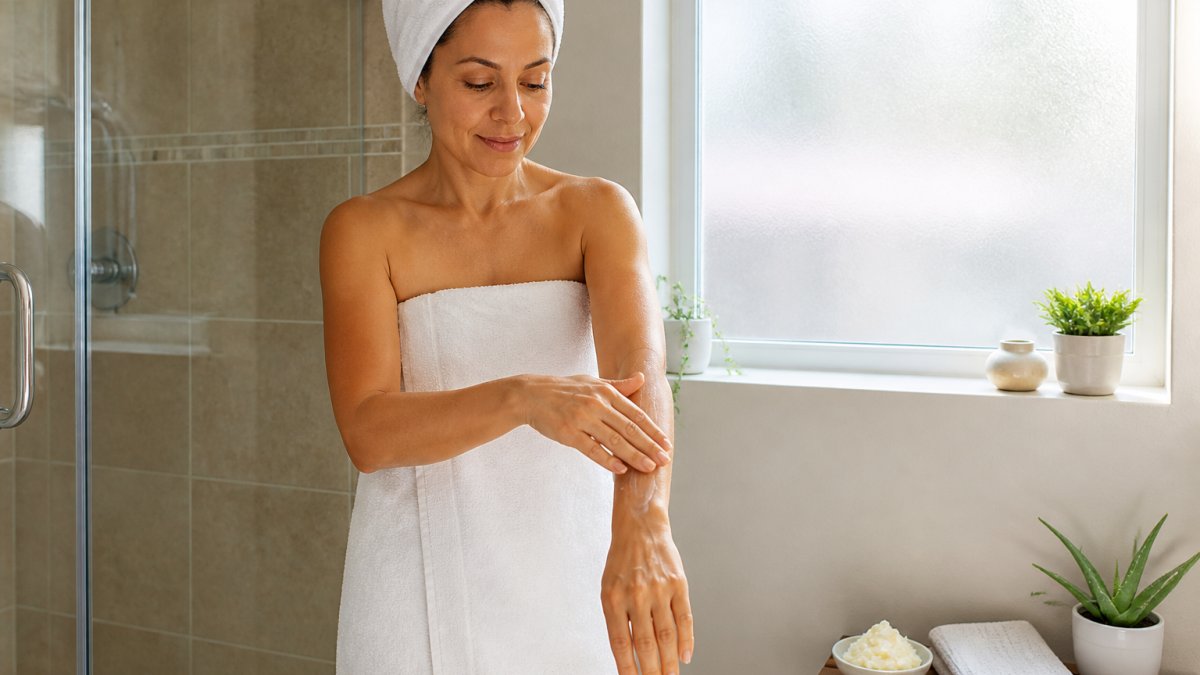
Here's the sequence:
- Step out and pat dry, leaving skin slightly damp
- Apply lotion or cream within three minutes
- Use circular motions, working from ankles upward
- Give rough areas a second pass
For very dry skin, a rich occlusive works harder than a light lotion. Velvet Reserve Pure Shea Butter is unrefined, plant-based, and rich in vitamins A and E.

Step 4: Layer a Body Oil Where You Want the Glow
Body oil goes on after moisturizer, not instead of it. Moisturizer holds water in. Oil seals it and adds shine.
Use oil on arms, shoulders, shins, and collarbones. Skip areas prone to breakouts. A few drops warmed between palms is enough.
Velvet Reserve- Pure Shea Butter for dry skin and hair →
For a ritual that doubles as self-care, massage oil in slow circular motions. The Lymph Love Body Oil blends jojoba, black cumin, and broccoli seed oils with frankincense, cypress, and rose.

Add a minute of deep breathing while you work it in. It sounds soft, but relaxation lowers stress, and stress shows on skin.
Your Morning Body Care Routine, Compressed to Five Minutes
A morning body care routine doesn't need to be long. It needs to be repeatable. Here's the compressed version:
| Step | Action | Time |
|---|---|---|
| 1 | Lukewarm shower with pH-balanced wash | 3 min |
| 2 | Pat dry, leave skin damp | 30 sec |
| 3 | Moisturizer within three minutes | 1 min |
| 4 | Body oil on arms and shins | 30 sec |
| 5 | Sunscreen on exposed skin | 30 sec |
Sun protection is the step people skip, and it's the one that protects every result above. UV exposure breaks down collagen and worsens uneven texture over time. The La Roche-Posay Anthelios UVMune 400 SPF50+ Sunscreen Milk is lightweight and non-greasy, and it's formulated for sensitive skin. Apply fifteen minutes before heading out and reapply every two hours outdoors.

A Body Care Routine for Glowing Skin Across the Week
Consistency beats intensity. A weekly rhythm looks like this:
- Daily: cleanse, moisturize within three minutes, sunscreen
- Two to three times a week: exfoliate
- Daily or as needed: body oil on dry areas
That recovery day matters. Skin repairs itself between exfoliation sessions, and giving it one day off prevents the irritation cycle that makes texture worse.
A Realistic Weekly Calendar
Here's how the steps fit together without overdoing active ingredients. Adjust exfoliation days based on your skin type (see below).
| Day | Cleanse | Exfoliate | Moisturize | Oil | SPF | Notes |
|---|---|---|---|---|---|---|
| Monday | ✓ | , | ✓ | ✓ | ✓ | Recovery from weekend |
| Tuesday | ✓ | ✓ (scrub or acid) | ✓ | , | ✓ | Exfoliate after shower |
| Wednesday | ✓ | , | ✓ | ✓ | ✓ | Recovery day |
| Thursday | ✓ | ✓ | ✓ | , | ✓ | Alternate method if desired |
| Friday | ✓ | , | ✓ | ✓ | ✓ | Shave day? Skip exfoliation |
| Saturday | ✓ | ✓ (optional) | ✓ | ✓ | ✓ | Only if skin feels calm |
| Sunday | ✓ | , | ✓ | ✓ | ✓ | Full recovery |
This calendar assumes two exfoliation sessions per week. If your skin tolerates three, add Saturday. If you shave, do it on a non-exfoliation day or 24 hours after exfoliating to reduce irritation.
Adapting the Schedule to Skin Type and Concerns
- Dry skin: Exfoliate twice weekly with a scrub or lactic acid. Use a rich butter or cream daily, and add oil on top at night. Consider a humidifier in winter.
- Sensitive skin: Exfoliate once weekly (Wednesday or Saturday). Skip dry brushing. Use fragrance-free products and patch test new items. Keep showers lukewarm and under 10 minutes.
- Oily or acne-prone skin: Exfoliate two to three times weekly with salicylic acid. Moisturize daily with a lightweight lotion, skipping moisturizer can increase oil production. Shower soon after sweating.
Seasonal and Climate Adjustments
- Cold or dry weather: Increase moisturizer richness, reduce exfoliation to once or twice weekly, and keep shower temperature lukewarm. Add a humidifier if indoor heating dries you out.
- Hot or humid weather: Lighten moisturizer to a lotion or gel, shower after sweating, and reapply SPF every two hours outdoors. Exfoliation can stay the same, but watch for irritation from friction.
- Limited mobility or time: Combine steps, use an in-shower moisturizer or a moisturizing body wash, and apply SPF in the same step as your morning moisturizer. A two-minute routine (cleanse, moisturize, SPF) done daily beats a ten-step routine done rarely.
Measuring Progress and Setting Expectations
"Glowing" is not a clinical term. For most people, it means skin that feels smooth, looks even-toned, and reflects light without flaking or dullness. Expect changes in two to four weeks, not two days, skin cell turnover takes about 28 days in adults.
Signs it's working: skin feels soft after moisturizing, rough patches smooth out, less flaking under clothing, and a visible sheen in natural light. Signs to pull back: stinging, new redness, itching, or breakouts.
How to Tell It Is Working (and When to Pull Back)
Expect changes in two to four weeks, not two days. Skin cell turnover takes time, and results build slowly.
Signs it's working:
- Skin feels soft right after moisturizing
- Rough patches on elbows and heels smooth out
- Less flaking under clothing
Signs to pull back:
- Stinging when water hits your skin
- New redness or itching
- Flaking that wasn't there before
If any of those appear, drop exfoliation for a week and simplify to cleanse plus moisturize.
The hardest part isn't finding products. It's building a routine simple enough to keep on a tired Tuesday.
Our collection pairs a gentle cleanser, a scrub, a rich butter, and a protective SPF into one coherent routine. If you'd rather start with a single targeted step, the PDRN Brightening Serum slots easily into the moisturizing stage for anyone chasing a more even, luminous tone, and the full lineup lives in The Chosen Collection.
Get started with CHOSEN WELLNESS and build a body ritual you'll actually keep.
Frequently Asked Questions
How often should I exfoliate my body for smoother-looking skin?
Two to three times a week suits most people. A body exfoliation routine works best when it is predictable: pick fixed days, use a physical scrub or exfoliating glove with light pressure and circular motions, and skip it entirely on days when skin feels tight, stinging, or sunburned. Over-exfoliation shows up as irritation, flaking, and stinging in warm water, and it undoes the glow you are chasing. If you shave, exfoliate the day before rather than right after, and moisturize within minutes of stepping out of the shower.
Should I moisturize my body every day?
Yes, daily moisturizing is the single habit that most reliably keeps skin looking radiant. Apply body lotion or a richer cream to damp skin within about three minutes of toweling off, while the skin barrier is still holding water. People with dryness or rough patches on elbows, knees, and heels may want a second application at night. Consistency matters more than the number of products: one well-applied moisturizer used daily outperforms three applied occasionally.
What should I apply after showering to keep my skin hydrated?
Reach for a moisturizer first, then seal it with an oil if you want extra glow. Pat skin damp rather than rubbing it dry, smooth on a lotion or cream with ceramides, then press a few drops of body oil over the top on areas like shins and shoulders. Keep the shower lukewarm rather than hot, since very warm water strips lipids and leaves skin tight. Finish with broad-spectrum sunscreen on exposed skin if you are heading outdoors.
Can simple body rituals really make skin glow in a week?
You can see a visible difference in about seven days from better hydration and gentler cleansing, mostly in smoothness and light reflection rather than deep change. Real improvement in skin texture and tone takes four to six weeks of consistency. Set expectations accordingly: glowing skin comes from a repeatable body care routine for glowing skin, not a single product. Track it by how skin feels after towel-drying and how makeup or clothing sits on your shoulders and legs.