
Table of Contents
- Why Fine Lines Form and What Actually Works in 2026
- Retinol for Fine Lines: The Gold Standard (With a Gentler Path)
- Best Face Creams for Fine Lines and Wrinkles: What to Look For
- Sunscreen for Aging Skin: The Non-Negotiable Step
- Building an Anti-Aging Skincare Routine That Fits Your Life
- Realistic Timelines: How Long Until You See Results?
- Conclusion: Your Next Step Toward Smoother Skin
- Frequently Asked Questions
Last Updated: October 14, 2026
Why Fine Lines Form and What Actually Works in 2026
Effective skincare for fine lines in 2026 starts with one honest distinction: not every line on your face responds to the same ingredient. At CHOSEN WELLNESS, we see this confusion constantly.
Fine lines are shallow creases that appear where skin has thinned and lost moisture, often visible first around the eyes and mouth. Wrinkles are deeper grooves etched into the dermis over years of sun exposure and repeated movement.
Dynamic Wrinkles vs. Static Fine Lines
Dynamic wrinkles appear only when you move your face: smiling, squinting, raising your brows. Static fine lines are visible at rest. This matters because the two respond to different approaches. Topical skincare can soften static lines and improve skin texture over time.
That's not a reason to skip topicals. It's a reason to stop expecting a serum to do a job it was never designed for.
Retinol for Fine Lines: The Gold Standard (With a Gentler Path)
Retinol for fine lines remains the most studied over-the-counter ingredient for improving the appearance of skin texture and smoothness. It works by speeding up cell turnover, which helps skin look more even and polished over time. The catch is tolerance. Retinol can cause redness, peeling, and stinging, especially in the first few weeks, and that's where most people quit.
How to Introduce Retinol Without Irritation
Start with two nights per week, not seven. Apply to dry, cleansed skin, use three to four drops for the whole face and neck, and follow with moisturizer. Add a third night only after two weeks without irritation.
Our Retinol + Peptide Face Serum pairs retinol with peptides and soothing bisabolol, so the refining step comes with a softer landing.

Best Face Creams for Fine Lines and Wrinkles: What to Look For
The best face creams for fine lines and wrinkles do two jobs: they hold water in the skin and they support the skin's own structure. Anything else on the label is a bonus, not a requirement. Look for humectants like hyaluronic acid and glycerin, occlusives that lock moisture in, and peptides listed among the first several ingredients rather than at the very end.
Peptides, Collagen, and Hydration: The Supporting Cast
Peptides, the short chains of amino acids, are what we look for in a firming formula.
Hydration is the unglamorous hero. Plump, well-moisturized skin reflects light more evenly, which is why fine lines look softer within days of consistent moisturizing, long before any structural change occurs.
| Concern | Ingredient to Look For | Where It Fits |
|---|---|---|
| Dryness and dullness | Hyaluronic acid, glycerin | Morning and night |
| Fine lines, texture | Retinol, peptides | Night |
| Firmness and elasticity | Peptides | Morning and night |
| Uneven tone | Vitamin C | Morning |
| Puffiness around eyes | Acetyl tetrapeptide-5 | Morning and night |
A Hyaluronic Acid Serum layered under a Peptide Moisturizer covers hydration and firming in two steps. For the eye area specifically, a Peptide Eye DePuff & Smooth gel-cream targets puffiness and plumps the look of fine lines without a heavy finish.


Sunscreen for Aging Skin: The Non-Negotiable Step
Sunscreen for aging skin is the single highest-return step in any anti-aging routine. Most visible aging is driven by cumulative UV exposure, which breaks down collagen and elastin over decades. No serum outperforms that. A broad-spectrum sunscreen with SPF 30 or higher, worn daily, protects every other investment you make.
The Details Most Guides Skip
The gap between "I wear sunscreen" and "sunscreen is actually working" comes down to three variables: amount, reapplication, and coverage.
- Amount. The SPF number on the label is tested at 2 milligrams per square centimeter of skin. In practice, that is roughly a nickel-sized amount for the face and neck alone, or the length of two fingers. Most people apply a quarter of that, which drops real-world protection well below the labeled SPF.
- Reapplication. Every two hours during sun exposure, and after swimming, sweating, or toweling off. A single morning application does not carry you through an afternoon outdoors.
- Coverage. Ears, hairline, neck, backs of hands, and the eyelids are the most commonly missed zones, and they are also where fine lines and pigment show up first.
Mineral vs. Chemical: An Honest Trade-Off
Mineral filters (zinc oxide, titanium dioxide) sit on top of the skin and deflect UV. They tend to be better tolerated by reactive or post-procedure skin, but they can leave a white cast on deeper skin tones.
The right answer is the one you will actually reapply. A tinted mineral formula solves the white-cast problem for many people and doubles as light coverage. A chemical formula with modern filters feels weightless under makeup.
Prevention Beyond the Bottle
Sunscreen is the anchor, not the whole plan. The behaviors that compound UV and mechanical damage are worth naming:
- Smoking. Constricts blood vessels and degrades collagen and elastin. It is one of the strongest independent predictors of early wrinkling, separate from sun exposure.
- Sleep position. Sleeping face-down or on the same side night after night can contribute to sleep lines that deepen over time.
- Repeated facial tension. Squinting without correction, habitual brow furrowing, and untreated dry eye all feed dynamic lines.
Sunscreen is one layer of a plan, not a substitute for one.
Building an Anti-Aging Skincare Routine That Fits Your Life
An anti-aging skincare routine only delivers if you'll actually do it. Complexity is the enemy here. Four steps, done consistently, beat ten steps abandoned by week three.
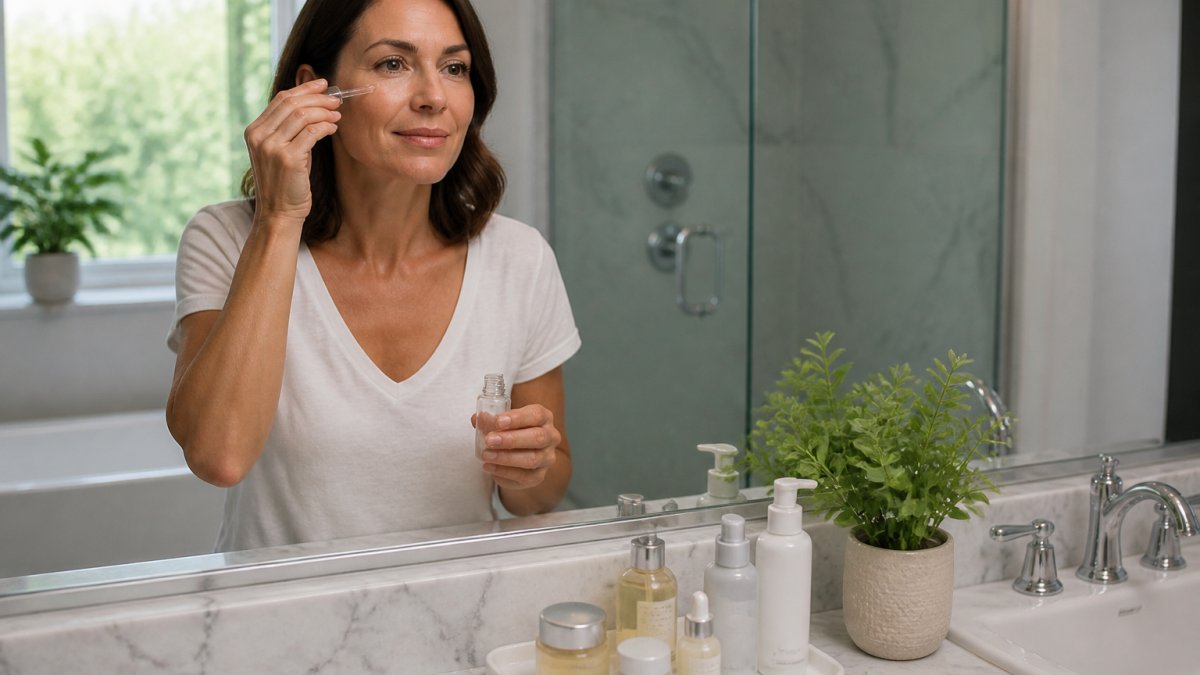
The Base Framework
Morning is defense: gentle cleanse, antioxidant (vitamin C), moisturizer, sunscreen. Night is repair: cleanse, active (retinol or a gentler alternative), moisturizer. That is the skeleton. Everything else is adaptation.
Retinol + Peptide Face Serum →
Sequencing: Why Order Matters
Thinnest to thickest, water-based before oil-based. This is not arbitrary. A heavy occlusive applied first creates a barrier that keeps lighter actives from reaching the skin. The practical order:
- Cleanser
- Toner or essence (optional)
- Water-based serum (vitamin C in the morning, peptides any time)
- Treatment (retinol at night, on dry skin)
- Moisturizer
- Sunscreen (morning only)
Wait about a minute between the retinol step and moisturizer. Applying moisturizer immediately over retinol can dilute it and reduce efficacy, though it does reduce irritation. If your skin is reactive, that trade-off may be worth it.
Adapting the Routine by Skin Type
Sensitive or reactive skin. Start with three products at night: gentle cleanser, moisturizer, sunscreen in the morning.
Dry skin. Layer a hyaluronic acid serum on damp skin, then a ceramide-rich moisturizer, then a thin occlusive layer at night.
Acne-prone skin. Retinol is actually helpful here because it speeds cell turnover and helps keep pores clear. Avoid heavy creams and oil-based occlusives.
Frequency: The Variable Most People Get Wrong
Retinol is not a nightly product for most people, at least not at first. A common pattern is two nights per week for two weeks, then three, then four, adding a night only after two weeks without redness or peeling. Some people never reach nightly, and that is fine. Three nights per week consistently outperforms seven nights followed by a two-week irritation break.
Cost and Value Over Time
Transparent math makes decisions easier. A $30 serum used twice daily typically lasts about two to three months, which works out to roughly $10 to $15 per month. A $60 moisturizer used once nightly can stretch four to five months, or about $12 to $15 per month.
The trap is buying five mid-priced products that each get used twice and abandoned. Two products used to completion beat five used sporadically, both in results and in dollars per month.
Safety and Contraindications
- Pregnancy and nursing. Skip retinoids entirely, including tretinoin and adapalene. Bakuchiol is often positioned as a pregnancy-safe alternative, but confirm with your physician before starting anything new.
- Prescription interactions. If you use tretinoin, do not layer it with over-the-counter retinol or strong acids on the same night. Alternate nights instead.
- Post-procedure skin. After lasers, peels, or microneedling, pause all actives until your provider clears you. Barrier repair comes first.
Realistic Timelines: How Long Until You See Results?
Hydration results show up first, often within a week. Skin feels softer and looks less crepey. Texture and tone changes from retinol typically take eight to twelve weeks of consistent use, which is why so many people give up at week four. Firmness and elasticity improvements from peptides build gradually over a similar window.
Judging a product at three weeks tells you almost nothing. Judge it at twelve.
Conclusion: Your Next Step Toward Smoother Skin
The hardest part of effective skincare for fine lines in 2026 isn't finding ingredients. It's building a short routine you'll repeat long enough to see results. CHOSEN WELLNESS curates results-driven skincare so you skip the endless scrolling and start with products matched to your goal. Explore The Chosen Collection and shop by goal, with 30-day returns on unopened items.
Frequently Asked Questions
What is the best product to use for fine lines and wrinkles?
There is no single best product, but a retinol serum used at night is the most studied option for softening fine lines. Pair it with a peptide moisturizer to support firmness and a broad-spectrum mineral sunscreen every morning. For extra hydration, a hyaluronic acid serum can plump the skin and reduce the appearance of dryness-related lines. Consistency matters more than finding one miracle product.
How long does it take for skincare to improve fine lines?
Most people notice smoother texture within 4 to 6 weeks of consistent use. Visible softening of fine lines typically takes 8 to 12 weeks, and deeper wrinkles may need 3 to 6 months. Retinol and peptides work gradually by supporting collagen production and cell turnover, so results build over time. Take progress photos every few weeks to track subtle changes.
Can moisturizer reduce the appearance of fine lines?
Yes, a good moisturizer can temporarily plump the skin and make fine lines look less pronounced, especially lines caused by dehydration. Ingredients like hyaluronic acid and peptides draw in moisture and support the skin barrier. However, moisturizer alone will not erase deeper wrinkles. It works best as part of a full routine that includes retinol and sun protection.
What are the new face treatment trends for 2026?
In 2026, expect more focus on multi-tasking peptide serums and mineral sunscreens with tinted formulas. The biggest shift is toward personalized routines based on skin type and tolerance rather than one-size-fits-all regimens. Gentle, consistent care is replacing aggressive exfoliation.
Can skincare make you look younger?
Skincare can improve skin texture, even tone, and soften fine lines, which collectively help you look more refreshed. It cannot reverse deep wrinkles or loss of volume the way in-office treatments can. A consistent routine with retinol, peptides, antioxidants, and sunscreen delivers the most noticeable improvement. Think of it as maintaining and enhancing your skin, not turning back the clock.
Which skincare ingredients are most effective for fine lines?
Retinol is clinically studied for fine lines. Peptides support collagen and firmness. Hyaluronic acid and glycerin hydrate and plump. Vitamin C provides antioxidant protection and brightens. Sunscreen prevents further damage. A combination of these ingredients in a consistent routine gives the best results.
How should I build a skincare routine for fine lines?
Start with a gentle cleanser, then a hydrating serum or moisturizer. At night, apply a retinol serum 2 to 3 times per week, building up tolerance. In the morning, use a vitamin C serum and always finish with broad-spectrum sunscreen. Add a peptide eye cream for crow's feet. Keep the routine simple and adjust based on how your skin responds.